


The world of theater keeps on captivating the audience with the most unprecedented, boisterous dramas and scenes from life. But life creates such stories that the great playwrights never dreamed of. There is one similar story in Brooklyn’s history, the Brooklyn Theatre Fire. The drama of this tragedy is not just about the number of victims, it caused irreparable damage to the theater world.
The fire that occurred on December 5, 1876, took almost three hundred lives. The Brooklyn Fire was one of the three worst fires in the United States. Read more at brooklyn-trend.com.
The Exterior of the Theatre
The theater was located on the corner of Washington and Johnson Streets, to the north of Brooklyn’s City Hall. The theater was huge for those times. Its seating capacity was up to 1,500 spectators. Mansard roof of the building was the most eye-catching element to the people. The theater opened its doors in 1871. The press often called the Brooklyn Theatre the main among others of the borough.
The theater was long run by married couple Sara and Frederick B. Conway. The Conways had rich experience in theater management. The Brooklyn Theatre flourished under their leadership. Later, the management passed into the hands of their children and the theater fell into decline.
In its heyday, the Brooklyn Theatre was the heart of theatrical life not only in the borough but in all of New York. Its location near Fulton Street and Manhattan ferries made it available to any New Yorker. The theater stage was known for hosting prominent visitors and actors. Plays by world authors were adapted for the American audience and presented on the stage of the Brooklyn Theatre. One such play, The Two Orphans, was shown to the spectators on that disastrous evening when the fire broke out.
The place of the incident was the theater
The designers of the building are often blamed for fires that affected a lot of people. Well, sometimes it is actually the case. The absence of fire exists, violation of the building regulations, etc., lead to a large number of victims. But this is not about the Brooklyn Theatre. Thomas R. Jackson was the designer of the building, and the construction was managed by Sara Conway herself. After the fire, the police inspected the building and concluded that it was designed according to all fire safety regulations. The Brooklyn Theatre had more emergency exits than any other cultural and administrative building in the borough of the time. This means that there were other reasons for the death of people. Nearly 1,500 people could leave the theater through the main exits onto Washington and Johnson Streets in 5 minutes. In addition to the main exits, there were three more back doors.

The interior of the Brooklyn Theatre was no different from other 19th-century theaters. There was a stage, lobby, and back of the stage for moving everything necessary for productions, like scenery, costumes and props.
The stage itself was lit by gas lamps, they lit up the curtains and decorative border. This type of lighting had some inconveniences. All actors were not allowed to smoke on stage or anywhere near the lamps. It was also forbidden to light them from matches or other open fires. These are the lamps that ruined the Brooklyn Theatre.
Sequence of events
The fire occurred at 11.00 pm between the fourth and fifth acts. One of the gas lamps inflamed near the curtain. The fire immediately attracted the attention of the actors and the audience. The troupe tried to calm the people, stop the panic and manage their evacuation. But human fear was stronger. The panic could not be quelled and people rushed out of the theater building. The lower part of the hall got out quickly and unhindered while people in the gallery started crowding. The passages and stairs were narrow, which, combined with panic, led to a stampede.
The police and fire department arrived quickly enough, but the pungent smoke filled the gallery faster than people could get out. They tried to go down a small staircase. The theater had many exits, but its stairs were not wide enough to allow people to come down quickly.
By that time, the greatness of the theater was already in decline. The theater could seat over 1,500 spectators in its glory years. But on that deadly evening, there were just over a thousand people in the house.
The props of the play helped to spread the flame. Instead of a curtain, there was a painted canvas on a wooden frame, and the stage was covered with straw. All these materials are flammable.
According to the production director, J.W. Thrope, the cause of the fire was the paper canvas. One of its pieces was torn off, slipped through the wire mesh of the lamp and caught fire. Then the fire spread all over the place. The fire started in a small area that could be easily extinguished, but there was no bucket of water on the stage. It was also impossible to get to the fire hose because of the scenery. People could not extinguish the flame with improvised means.

Despite the desperate situation, the actors appeared on the stage after the break. They tried to continue their performance to calm the audience. When the flame spread to the loft, the play was over.
Fighting the flame
When the loft caught on fire, stage personnel tried to knock down the flames with long sticks. However, this resulted in smoldering pieces of material falling behind the scenes onto the sets and props. This caused the additional extension of fire to new parts of the backstage.
When the audience saw the first flames, a panic broke out. The actresses managed to find their way out through the passage from the leading actress’ dressing room, bypassing the crowd in the lobby. The rest of the actors escaped through the utility doors exiting onto Johnson Street. As the fire first flared behind the scenes and then the stage, they could not use those exits.
Back then, the danger of fires was very high. Therefore, the staff was trained on how to deal with such situations. While the troupe tried to quell the panic, the head stage director went to open the back door in the eastern part of the lobby. It was supposed to lead to Washington Street, but it was rarely used, even as a precaution. That’s why the door’s hinges got rusted. Too much precious time was spent opening the door. The head assistant managed to open the door with some materials at hand. It saved the lives of several hundred spectators but also became the death for others. A new airstream came through the emergency door into the hall, which led to the fire escalation.
The lower tier had better ways of evacuation. Maybe because there were fewer people and no narrow stairs, like in the dress circle, they got out the fastest. The spectators who were sitting there had to fight their way through the jostling on the narrow stairs. This led to the stampede. One of the reasons for this was the panic, all the spectators rushed to exit through the stairs by which they came. They completely ignored evacuation advice. When the people from the dress circle managed to get to the lobby, they encountered another crowd of people. The lobby was overcrowded and the stairs from the circle were blocked. There was a crush. Yet all those visitors who stayed upstairs did not know that they were stuck and tried to go down, which only made things worse. This means malcoordinated evacuation.
People who knew the theater well enough went from the circle to the auxiliary stairs leading to Flood Lane. When they got there, they saw that the door was blocked. None of the police officers or firefighters remembered or opened these doors. They could save people’s lives.

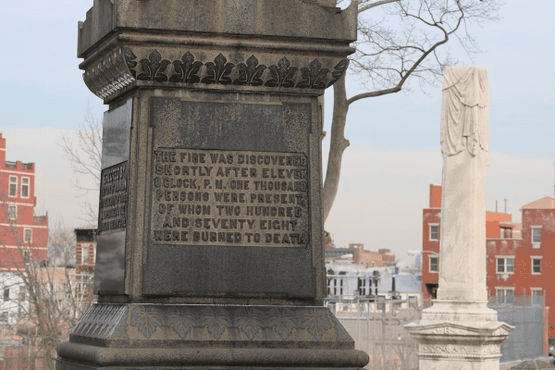
The fire was only partially controlled around 3 am. Most of the dead were buried in the Evergreen Cemetry in Brooklyn. Over a hundred unidentified bodies were laid to rest in a mass grave in Green-Wood Cemetry. The Brooklyn Theatre Fire became part of a tragic and bloody page in the borough’s history.